The Thing Beneath The Thing
2026-07-25
A few days ago, I pulled a slab of rough Peruvian Walnut from the bottom of the rack. It had been sitting there for months, covered in the dull, chalky patina that settles over wood exposed to a shop’s shifting humidity. To anyone walking past, it looked like a muddy, unremarkable plank. But when I sighted down its length, something caught my attention. It was straight. No cup. No crown. No visible twist. I was building a Peruvian Walnut version of my Still Horizon side table, and for a tabletop that’s almost everything you could ask for.
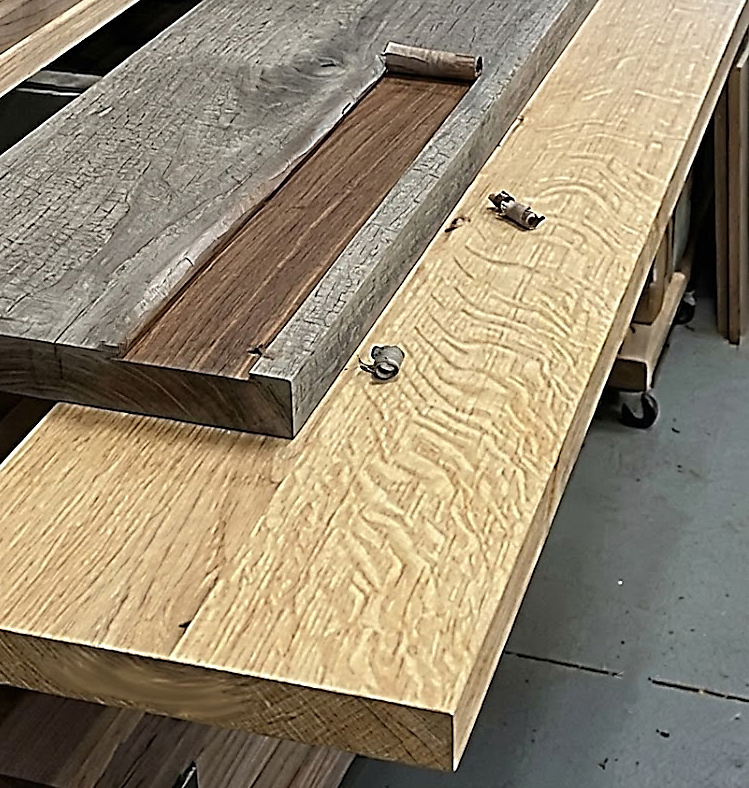
I clamped it to the bench and took a hand plane to the face.
The first pass didn’t yield the usual clean ribbons of wood. The iron skipped, catching on a hard, hidden resistance somewhere inside the density of the fibers. I stopped and wiped away the pale dust with the palm of my hand. Right where the blade had stuttered, the dull gray surface had split open, and underneath it was a hue so deep it looked almost violet under the shop lights. It was beautiful. It was also, possibly, a problem. A stutter like that under the plane usually means one thing: grain twist, buried just beneath a surface that gives away nothing from the outside. The mill marks and the weathering had created a false geography — a flat, honest-looking exterior sitting on top of something the saw and the eye had both missed. For a tabletop that needs to read as one continuous, unbroken line, that kind of twist isn’t texture. It’s a flaw. I ran my fingers across the exposed grain anyway, feeling the cool, polished density of a surface that hadn’t seen the sun in fifty years, and thought about what I actually knew about this piece of wood versus what I’d assumed about it earlier. Twenty minutes ago I was certain that this was the perfect board for my tabletop. And now? At that moment, I wasn’t certain of anything. Well, that’s not true. I was certain that I was disappointed. I had already cut the stock for the legs and the apron only to discover that my last four feet of Peruvian Walnut was useless as a tabletop. I was about to throw it in my scrap pile. Not because the board was entirely unusable, but out of frustration. It wasn’t usable for this project, but as I held it in my hands about to throw it on the woodpile where all the orphan boards and offcuts go to be forgotten, I turned the board over once more before tossing it on the pile. The grain that had disappointed me a moment earlier suddenly looked different. Not straighter. Not better. Different. I set it back on the bench. I left that board sitting on the bench all afternoon too disgusted to even look at it. I had spent nearly two hours milling the timber and cutting the legs for a table that would not get built. When I only get about 20 hours per week in my shop, wasting ten percent of that precious time is disheartening. Later as I was cleaning up the shop, I moved that infuriating board back to the stack. I just happened to lay it on top of a slab of white oak. I stopped. The face of that walnut board sat flat on the oak without so much as a hairline gap between them. I looked at the board once more. The plane hadn’t improved the walnut. It had only removed the evidence of everything that wasn’t essential — and in doing so, also removed my own assumption about what this board was for. The board never became a tabletop. The grain twist ran too deep, too unpredictably, to trust across four straight feet of visible grain. The wonkiness that disqualified this board from one piece turned out to be exactly what makes it interesting in another. Subtle deviation in the grain, in a small object held in the hand, or sitting a few feet away on a coffee table or mantle reads as character instead of failure. The grain, the color, the twist, all of it had been there before I ever clamped the board to the bench. I hadn’t chosen the wrong board. I’d just been asking the wood the wrong question. That board sits today in a five-light Tranquil Ember tray, wonky grain and all — a piece more honest, if less grand, than the tabletop I originally had in mind for it.
Essay Series: Origins of Latent Form Theory Themes: Material intelligence, perception, essential subtraction Author: Jason Deters